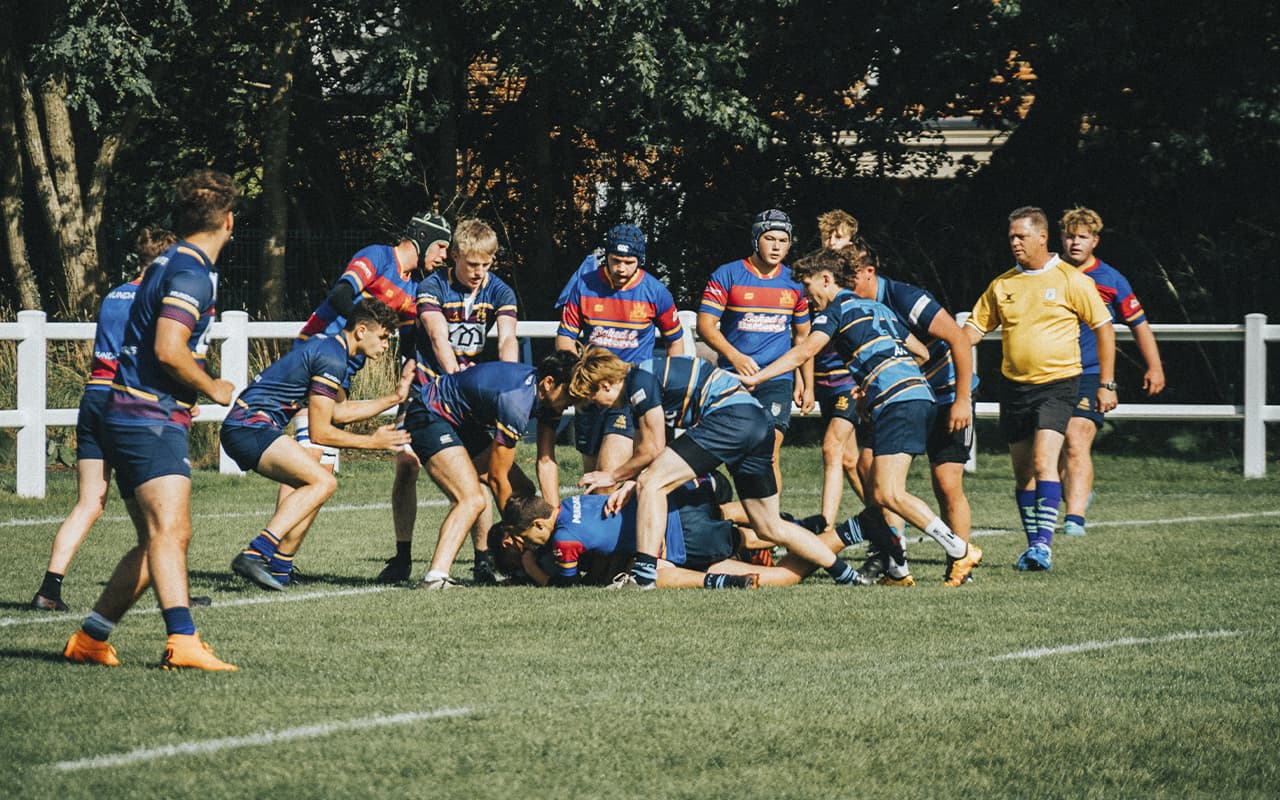
Know the basic rugby rules and enjoy rugby. Be confident. Know what's happening. Get into it. Easily find all details of the rugby rules when you want to. Improve your game.
Just scroll down or...
Select a topic for information about basic rugby rulesThe International Rugby Board (IRB) controls rugby and how it's played.
They control the "Laws of the Game - Rugby Union"
These rules tell us how to play.
Some rules are simple and necessary and easy to include.
Some rules are necessary to know but very complex and technical. So it's best to include just the most important parts of them when getting together basic rugby rules.
On this page get to know the basics. For some rules the basics are just a few words.
Where there is a link, click to get what you need to know. For full details of rugby rules, follow this link to the IRB Laws.
No rules specifically mention the rugby sidestep.
Sidesteps are special ways you move the ball towards the opposition goal-line when you are carrying the ball.
Lines everywhere! Some solid, some dashed. What do they all mean and which are most important?
Get to know more about the basic rugby rules by learning about the field, also known as the rugby pitch.
Look at the field. It's a great place to start your basic rugby rules. Easy, step by step, know the rugby field
Rugby ball
Bit of a weird shape for a ball!
True, but it does make the game pretty interesting.
Get to know the ball so you catch it well or predict where it`s going to bounce and where it will go after it bounces.
Imagine you can make the ball do what you want it to do, when you know all about the rugby ball
One of the simple basic rugby rules - maximum of 15 players on each side. With up to 7 substitutes allowed.
Rugby gear is shirt, shorts, underwear, socks and boots! - talk to current players for advice on kit - especially boots. Some minimal padding is allowed.
Two 40 minute halves, maximum of 10 minutes half-time break. Use any existing weather conditions, they may change (my advice!)
Referee and two touch judges. Being a match official is not easy, officials provide a great service and deserve support.
Very important in basic rugby rules, always remember the spirit of the rules of rugby...
Players run all over the place! What's going on?
It`s organised chaos, but things become clear when you understand very basic rugby
What's going on! They just broke the basic rugby rules, but the referee ignored it! Know and understand advantage.
Why have this team got more points than that one? Why are they trying so hard to get over that line? Why are they kicking at the posts?
Important in basic rugby rules.
Know about rugby tries and goals.
| Method of scoring | Points awarded |
|---|---|
| Try/Penalty try | 5 |
| Conversion | 2 |
| Penalty goal | 3 |
| Drop goal | 3 |
| . |
Foul play is doing anything in the game which is against the rules of rugby or the spirit of the rules.
This is one of the most important basic rugby rules. Be fair, play fair! This rule aims to keep injuries to a minimum.
Ignoring this rule is cowardly. It may result in serious injury to other players.
Improve your game, know this rule
Foul play includes
Remember, this is one of the most important basic rugby rules.
That player is right where the ball is. Why don't they pick it up?
It may be because they are offside. This is important in basic rugby rules. If they picked up the ball they would give away a penalty.
Here's a basic rule of thumb.
Aim to stay behind the ball.
Make sure the ball and the player in your team playing the ball are ahead of you in relation to the opposition goal line.
If not, avoid becoming involved in play.
Sometimes you accidentally mishandle the ball and knock it forwards off your hands or arms. You are allowed to try and regain control.
If you catch it again before it touches another player or touches the ground you can play on. Otherwise it is a "knock on" and play may be stopped.
They want to get the ball to the other end, don't they?
Why do they always throw it backwards!
It's because a pass or "throw forward" is not permitted.
Pass straight across the field...Yes, OK
Pass backwards towards your own goal-line...Yes, OK
Pass forwards towards the opposition goal-line... NO, not permitted!
The hands and any movement must direct the ball backwards (or level).
Because of the speed of the player passing the ball, it is possible (and permitted) that the ball travels forward from the point where the ball is released.
If you intentionally knock on or throw the ball forwards you may be penalized. If what you did prevents a probable try, a penalty try may be awarded.
The ball is kicked at the start of each half of the game and for all restarts.
The player kicking the ball must use a drop kick and all players must be behind the ball when it`s kicked - so always stay behind the kicker!
These kicks are taken from the centre of the halfway line
Kicks taken from the centre of the half way line must travel at least 10 metres.
A restart may be with a drop-kick taken on the 22 metre line.
Drop kicks from on or behind the 22 metre line need only cross that line. Find out about drop kicks and other kicks in Rugby Kicking.
Sometimes the player holding the ball ends up on the ground without actually being tackled. What happens now?
Know about ball on ground - no tackle.
When the ball carrier is tackled (brought to the ground) there are some things you must do and some things you must not do.
It depends on whether you are the ball carrier, the tackler or just another player.
You need to know about the rugby tackle.
The ball is right there on the ground, Shouldn`t they pick it up?
Sometimes you are not allowed to pick up the ball
It`s useful to know about the rugby ruck
They`re all grappling for the ball. What's going on!
Know about the rugby maul
They just caught the ball, and shouted "Mark". Then everything stopped. What's happening?
Know about the rugby mark
When the ball goes "into touch" the game is restarted with a line out. The ball is thrown into play between two opposing lines of players.
Find out more about this in the pages about how to play rugby.
Following some infringments of the rules play is restarted with a scrum.
Eight players from each time bind together in their own 3-4-1 formation in a crouching position.
The two formations engage each other head on to form a single mass off 16 players.
The ball is then put into the tunnel between the opposing formations and each team attempts to get control of the ball with their feet.
Find out more about the scrum in the pages about how to play rugby.
Depending on the seriousness of the offence, teams may be awarded a penalty or a free kick when the other team infringes the rules.
In the case of penalties, a kicker may elect to take a place kick shot at the goal posts. If the ball goes over the cross-bar points are awarded.
Visit the kicking skills section for more about place kicks.
In goal area
This is important in terms of basic rugby rules.
Grounding the ball in the opposition ingoal area results in points being awarded because this is how you score rugby tries. (See rule 9 for more try details)
Grounding the ball in your own in goal area makes the ball dead and play will be restarted. There is no conept of an "own try" unlike football (soccer) where you can score for the opposition with an "own goal".
Probably the most important rule of all.
Nah...just kidding!
It`s not a rule at all...but it should be.
You`ll enjoy rugby anyway but you`ll have much more fun when you learn to sidestep is the question now is the answer.
Now find out more about how you do rugby sidesteps so you will always be thinking about them and how you will be good when you learn with Evtechs
Make this one of your basic rugby rules!
The IRB's website has downloads for all the rules. They're very detailed. They have to be.
The rules downloads are large! Links for all the rules are given.
You can see variations of the basic rugby rules for...
If your first language is not English the IRB have it covered. You can read the rugby rules in other languages
It`s good to know the basic rugby rules, but.
There`s no substitute for knowing all the rules of rugby!
Now you`ve got the essentials, let them sink in. Then you can take in more of the details of rugby rules.
The more you know, the more confident you`ll be that you`re playing correctly. It`s important you avoid giving away penalties.
Fair play is the foundation for basic rugby rules.
Principles of the Game and Principles of the Laws are well worth reading.
They`re part of a huge document. Download it when you have plenty of time and plenty of disk space! It's the official IRB Law book.
Hang around or come back soon...
Select another rugby topic from the left hand menu so you become an expert.
Visit us on Facebook or stay and look at our Facebook rugby page.
Get your friends involved. If you enjoy this site and find it useful help them easily use this information too by using the "Share this page" facilty at the bottom of each page.
Now you know the basics have a look at some of the skills or how to play or find out more about positions...just use the menu!
There are two main things to avoid
Avoiding foul play is pretty easy. You know the basic rugby rules, you remember them and you play to them.
Tackles are a major part of rugby. When you are able to avoid them you have a fantastic advantage.
Just so you know what you can do, watch this short video.
Have a chuckle as you become aware of how you use a sidestep and find you can avoid tackles. <<<-- CLICK HERE!!
New! Comments
Like it? Questions? We`d love to know! Share it, comment below!!