Details of rugby positions and how you play them. Backs, forwards, wing, prop? Work out where you fit in, enjoy yourself, feel good and play well.
This is what it's all about, where you fit in.
This diagram shows all the player positions in a rugby team based on the situation where a scrum has been formed.
Rugby positions based on the scrum
Back row [Flankers] [Number 8]
Half-backs [Scrum-half] [Fly-half]
Three-quarters and full-back [Centres] [Wings] [Fullback]
A team needs different sizes and shapes of player with different skills, qualities and temperaments.
The higher the level you want to play, the more important this becomes.
Age, physical characteristics and grade may affect your choice so it's a good idea to start with the basics.
Next step... Return to Select a topic
Each rugby team has 15 players on the field at any one time. Each player has an allocated place on the field.
Knowing the position you have been allocated helps you understand and remember what you need to do during the game and where you need to be on the pitch.
The individual rugby positions in a team are in two major groups the "forwards" and the "backs".
Next step... Previous step... Return to Select a topic
There are 8 forwards in a team.
They tend to be the bigger, stronger, heavier players in the team.
These are the players who use size and strength to get the ball and move it towards the opposition goal-line.
They`re also the rugby positions known collectively as "the pack".
Forwards take part in "set piece" contests for the ball.
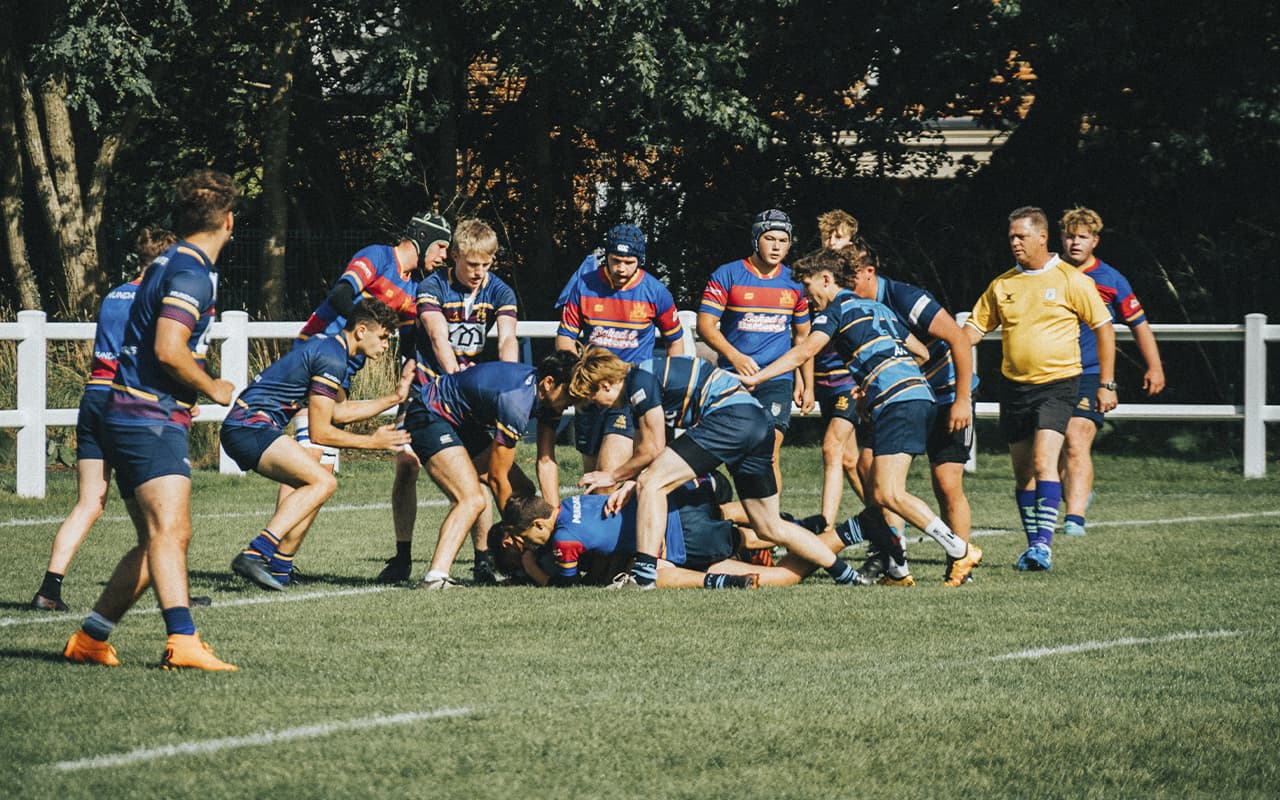
One is known as a "scrum", where forwards from both teams pack together using their bulk, strength and ability towork together to get the ball.
Another is called a "line-out" where the forwards contest for possession of the ball after the ball has gone out of play over the side line.
During the the course of a game it is usually clear which team has possesion of the ball. You can see it being passed from hand to hand as players run with it.
At other times it becomes unclear which team has possession. Informal struggles for the ball take place. It's usually and mainly the forwards who struggle to gain possession but any player can be involved in it.
When the ball is on the ground it's called rucking.
When the ball is off the ground it's called mauling.
Find out more about rucking and mauling in the section on how to play rugby.
The "forwards" also work together in defence, co-operating to stop the opposition from moving the ball towards your goal-line.
There are groups within the pack named in relation to the places they take up in a scrum.
Next step... Previous step... Return to Select a topic
Front row of the scrum
The front row forwards group are the props and hooker. The props are numbers 1 and 3, the hooker is number 2.
The two props are highly specialised roles.
For scrummaging you require size, strength and pushing technique.
Always Loose head prop on the Left.
Always Tight head prop on the Right..
In the line-out you assist the locks into the air to contest for possession.
Find out more about playing prop.
The hooker usually throws the ball into the line-out and is always in the centre of the front row in a scrum where the hooker must strike with his or her leg to get possession of the ball.
For more detail visit the page about playing hooker.
Next step... Previous step... Return to Select a topic
The second row of the scrum
The second row group contains lock and lock - yes there are two of them! They are numbers 4 and 5.
The locks tend to be strong and tall. In the scrum you provide stability and go forward power to push the opposition off the ball.
In line-outs you are the tall timber. You are thrown into the air at the right moment to receive the ball thrown by the hooker or contest for possession when the opposition throws in.
Find out about playing lock.
They are called lock forwards
Players in the front row and the second row positions are collectively called the "tight five" because they are all bound tightly to each other in scrums.
Next step... Previous step... Return to Select a topic
Back row of the scrum
The back row group contains flankers and the number eight position. The flankers are numbers 6 and 7, the number eight is number 8, believe it or not!.
In these positions you are at the back of the scrum and the back of the line-out.
When your side wins the ball you break quickly. You're involved in moves, you carry the ball forward or run in support of others.
When the opposition wins possession your break quickly, break up attacks and regain possession.
There are two flankers, usually positioned as blind-side and open-side. Find out more about playing flanker.
The big player at the back is the number eight.
Players in the back row are also called "loose forwards" as they are bound only loosely to the other forwards.
They break from the scrum quickly and easily to do their work and have, in the past, been known as "break-aways".Next step... Previous step... Return to Select a topic
The backs provide more of the speed, agility and evasiveness required in many cases to score tries.
They tend to be smaller, faster, more elusive players.
This is only a guide! Many are large and fast!
Many are not elusive!
This is good, for you. Be elusive. It gets you in the team and it`s a great advantage for your side.
You`re a good back when you have good individual skills in running, passing, catching, kicking and tackling.
Backs move the ball to search out or create weaknesses in defence.
When you find weakness, you still need to get the ball through the opposition, so use your speed and evasion skills.
There are groups within the backs named in relation to... I`m not sure what!!!
Next step... Previous step... Return to Select a topic
Half-backs with a scrum
The half-backs group contains these key positions - scrum-half (number 9) and fly-half (number 10).
When you are the scrum half you put the ball into the scrum.
When the ball comes out you get it to the fly-half quickly.
You may also be involved in moves with the back row or sometimes make breaks yourself to keep the opposition on their toes.
Find out how you play scrum-half..
As fly-half you are usually responsible for calling the shots. Most teams will have some set plays. You have to decide which are used and when.
Find out more about
how you play fly-half
(or any of a dozen other names!!!), making the big decisions.
Next step... Previous step... Return to Select a topic
The three-quarters in relation to a scrum
The rugby positions group of three-quarters contains the centres (numbers 12 and 13), wings (numbers 11 and 14) and that leaves the full-back, number 15.
For these positions you need speed, agility and tactical sense.
As a centre you will generally follow the lead of the fly-half, taking part in tactical moves designed to break through opposition defence.
You will also be expected to use your skills to take advantage of lapses in defence by catching the ball at speed and carrying it forward.
You will be expected to run straight and be able to catch and pass well under pressure.
Find out
more about the centre three-quarters
(there are two of them, usually positioned as inside and outside).
As a wing you will be fast and elusive. You will also need "Good hands" - the ability to catch well. You will be receiving the ball while running at high speed and often passed by a player under pressure.
Find out
how you play wing three-quarter
(two of them, usually positioned as left and right).
That leaves one player. No group for this one, the full-back.
As a full back you will develop a great ability to read the game.
Although you are usually the last line of defence you have a real role to play in attack.
Speed will enable you to join in attack with the three-quarters, bursting through in support as the set play or unfolding play requires.
Find out how you play full-back.
Next step... Previous step... Return to Select a topic
This is a trick position - the op...position!
This is about the other lot. You beat them and win the game.
This section is to tell you the best way to defeat the opposition is to find out all about how you do it with EvtecHs Evasion TecHniques
You`ll be pleased you did, it`s all about how you avoid tackles. when the opposition are trying to put you on the floor!.
So, that`s it for rugby positions.
Work out where you would play well and
... learn to sidestep so you
...... play good rugby then find and
......... help others
............ be a team, above all remember,
............... have fun!!.
Next step... Previous step... Return to Select a topic
Size is important. For some positions bulk and weight are an advatage. For others, height. You can be too tall for some.
Relative size can be important too.
Being a huge prop may be an advantage or not. Too big in relation to the hooker and the other prop may result in an unbalanced scrum.
If you have he right knowledge, skills, qualities and attitude you may still excel even if you are not the ideal size.
In the lower levels of rugby there is a huge variation in the sizes of players playing in any given position.
The higher you go, the more important size becomes in rugby positions, but even at the elite level variations still exist.
For example locks need height but not all locks are the same height. Somewhere, some player is the shortest lock!
Wings are getting bigger.But somewhere there will be the smallest winger. They may disadvantaged by size but beating opponents with superior evasion or blistering pace.
If you would like to know more about the range of sizes of players playing in rugby teams, we have a section dealing with player sizes.
It`s about the size of elite players so you can learn a lot when you look at the the relative sizes of players in the different positions.
Previous step... Return to Select a topic
New! Comments
Like it? Questions? We`d love to know! Share it, comment below!!