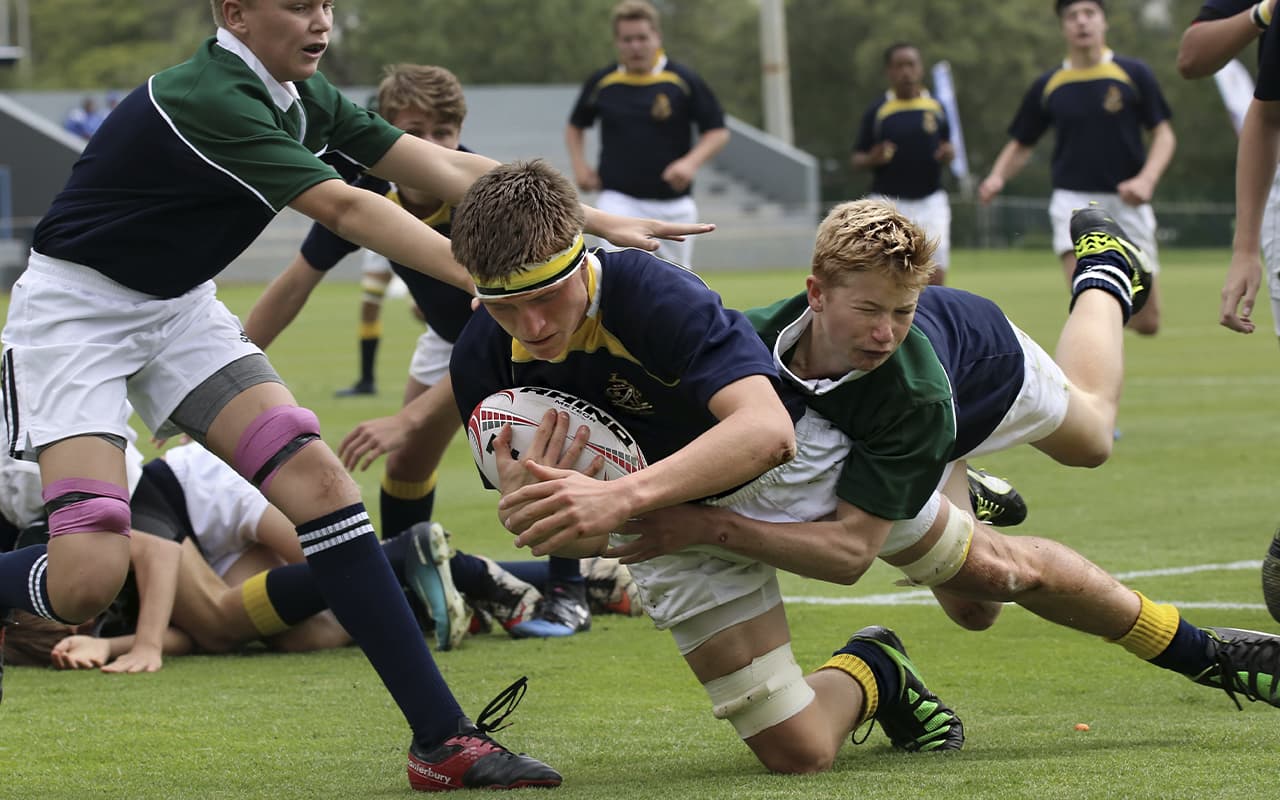
Rugby Sidesteps

Break through! Know how you use effective rugby sidesteps and break defences when you switch direction at will, in a flash. Do not think about it. Do it.

This answers questions like...

  • exactly what are sidesteps, steps or side steps
  • why do you use sidesteps

  • are there different types of sidestep
  • how do you know when to sidestep
  • how do you learn to sidestep

Go to "What are Rugby...", then keep pressing "Next"

or just select a topic

Sidestep FAQ

What are sidesteps - essentials

Why you use sidesteps

Sidesteps = evasion

Different types of sidestepping

Classic example, effective and damaging

Modern example - ok

Jinking

Bunny hops, leg waggles, two footed steps

Where you use sidesteps

How and when you sidestep - STEP BY STEP instructions

Sidestep history

Welsh sidesteps

Australian sidesteps

NZ sidesteps

Asian sidesteps

Golden Oldies sidesteps

Sidestep FAQ - fairly straightforward

- What are rugby sidesteps? You beat players with clever footwork.
- Why do they say sidesteps are exciting? Because it`s true!
- What do they look like? Fantastic! See video clips on this site.

- Done in a flash, but talked about for years? It`s true!
- What rules relate to rugby sidesteps? Just the basic rules.
- Where can you do a sidestep? Anywhere! Not just on the field.

More quick questions
- Which players do them? Players in any of the rugby positions can.
- Me, produce something from nothing with a sidestep? Absolutely!
- I`m new, help? Learn the basic rules then the clver footwork!

- What do I need? Strong legs, strong ankles, believe it`s possible.
- Where can I see a sidestep? Look for good rugby videos.
- Can I get a sidestep? Yes! You can do it on this site.

And some more!
- More than one sidestep? Sort of, there are a few variations.
- Could I be a sidestep sensation? You`ve got to believe it, practice!
- Is it easy to do rugby sidesteps? It`s easier than many think it is.

- Still talking about sidesteps 30 years later? True! See rugby clips.
- Have fun with rugby sidesteps? Certainly! For the rest of your life!
- Am I young enough/old enough to learn? Probably, if you think so!

Next step... Return to Select a topic

What are sidesteps - essentials

It's really just an easy way of saying

  • using your wits and agility
  • you change direction quickly and unexpectedly (switch)

Legendary player Gareth Edwards had this to say about being beaten by his friend, sidestepping legend Gerald Davies.

He could change direction by almost ninety degrees I knew that, but at ninety miles an hour! No one told me that
Gareth An autobiography, Gareth Edwards, 1978

You create confusion in the defence. Sidestepping when the defence is disorganised (broken play) is even more effective.

  • see weakness, switch direction, take advantage
  • OR switch direction, create weakness, take advantage
  • result - chaos in defence, you or support slash through

Because you are so unpredictable opponents

  • can't be certain what you'll do next
  • are not sure who is resposible for tackling you
  • they "hang off" tackles, especially if you have beaten them before

you create space and time for yourself and others.

You need to know

  • how to sidestep
  • when to sidestep

Have a look at rugby sidestep essentials. It`s about the things all sidesteps have in common.

Next step... Return to Select a topic

Why you use sidesteps

To score more tries, get more points, win more games you must get the ball past the defence.

You have two main options

  • Kick the ball - easy, but you lose control
  • Carry the ball - hard, but you keep control

So it`s usually best to carry the ball but it's harder for you, the ball carrier, because they tackle you. They throw you on the floor!

You make it more difficult for them to tackle you when you can sidestep. You have options others don`t even know exist.

You do things others believe impossible.

Swift passing and planned moves are good but with sidesteps you are totally unpredictable, very hard to tackle. They are very wary.

They worry about what you might do. They hang back, waiting, trying to read you. So you have more space and time and even more options and opportunities!

Where are you going, what will you do next, who should tackle you?

You create chaos and opportunities for yourself and supporting players.

Next step... Return to Select a topic

Sidestep = evasion - see what you can do

This video is a light-hearted introduction. However, the skills involved are deadly serious.. The video includes a number of different steps. Use these skills and you are a game-breaker.

You beat and baffle opponents!

See yourself
get out of impossible situations
attack through invisible gaps
create space or gaps by manipulating opponents
create chaos.

Invaluable and exhilerating for you
Devastating and demoralising for the opposition
Inspiring and encouraging for the team
Entertaining and exciting for anyone watching

Evade the opposition in a flash!
It`s how some famous players become famous!

Next step... Return to Select a topic

Different types of sidestepping

There are so many variations. So hard to describe. So we just call them sidesteps. Anywhere, anytime. Players cleverly evading each other. You may even need a slow motion replay to see it.

That's all part of the magic. It's over in a flash. We just say

  • steps off his/her left
  • jinking through
  • or simply, "Brilliant"

It's hard to give players' sidestepping actions clearcut names. I'll identify some typical sidesteps. Expect variations rather than exactly these actions.

You could start by looking at a few sidesteps on video.

Next step... Return to Select a topic

Classic example, effective and damaging

Very good, EFFECTIVE AND DAMAGING type of sidestep.

See what your opponent sees with this classic sidestep video clip.

Game-time views of classic rugby sidesteps are hard to view freely (because of copyright laws) but you will see one here at the classic sidestep where the sidestepper cuts inside the opponent.

Next step... Return to Select a topic

Modern example - ok

Rugby sidesteps have changed since the old days.

Changed, but not improved.

Unlike many rugby skills, the sidestep is in poor shape.

Look at the modern sidestep where the sidestepper cuts inside the opponent.

Next step... Return to Select a topic

Jinking

You can also move sharply sideways or even backwards when you evade would-be tacklers at slightly slower pace.

It's been called a sidestep. It's been called a jink. I'm using both names just to be sure! The rugby jink sidestep

Next step... Return to Select a topic

Bunny hops, leg waggles, two footed steps

There are plenty of other ways to evade tacklers. Some players appear to have ability but are unable to reproduce sidesteps which beat opponents consistently.

The attempts appear to be created in the moment or are attempts to copy others. These attempted steps tend to have a very low (close to zero!) success rate.

In this category are bunny hops, general leg waggles and two-footed rugby sidesteps. They sometimes work but are too varied and ineffective to include.

Next step... Return to Select a topic

Where you use sidesteps

You use evasion techniques like rugby sidesteps to slip through gaps or use them to create gaps to slip through.

How do you know where the gaps are or where you can create a gap? For more about how you see gaps, have a look at vision in rugby.

You play well when you can work out what to do several moves ahead. You need to know what`s likely to happen next in play so you can see weaknesses developing and use a step to take advantage. You can find out more on the page about reading the game.

Next step... Return to Select a topic

How and when you sidestep - step by step

Want to know exactly how to sidestep?
Do it with Step-by-Step Instructions on our Evtechs evasion page

Remember - practice enough and it becomes instinctive.

Only then - in the moment, without even thinking about it, you will truly know when to sidestep!

So get plenty of sidestep practice.

Next step... Return to Select a topic

Sidestep history

The earliest reference I've seen to rugby sidesteps mentions the year 1930. Documentary evidence suggests they were already part of the game at that time.

Mention of players like Bleddyn Williams and Peter Jackson using sidesteps comes later. These early sidesteps and rugby pioneers give some clues about the origin of the sidestep.

Sidesteps boom

The sidesteps boom came in the 1960's, 1970's and 1980's.

The boom was mainly driven by Welsh rugby players but also included a scattering of players from other nations.

Want to know more and sidestep well?

Chase down video of these players and find out what lesson there is to learn from the period when sidesteps boom.

Sidestep passes... does it?

As coaching took hold of the rugby world, more and more effort was placed on creating solid defence. Fewer sidesteps are seen.

Are the two linked?

It became so bad that an article in the The Independent newspaper, in November 1999 claimed " The sidestep passes into history..."

So, the sidestep passes into history, does it?

........Over my dead...... leg - don't want to go too far now, do we! I've been pretty close a couple of times already!

Sidesteps hang on!

The good news is that the sidestep is avoiding extinction!

I'm so HAPPY!

There is interest from around the world. This site caters for people new to rugby as well as for those who already know about the sidestep.

That's great - you'll learn the sidestep with all the other basic skills.

Next step... Return to Select a topic

Welsh sidesteps

Think Welsh rugby, think sidesteps, evasion, footwork, steps, trickery, wizardry, something from nothing, jinks and jinkers.

Of course many countries have players who sidestep - but it`s always the same country with most and best.

I base this on sidesteps captured on camera in high level games. Over the last several decades Welsh rugby is miles in front.

It`s a proud tradition - part of Welsh culture.

Before that?...

Read player autobiographies of sidestepping players and you'll see many references to playing

  • on small/narrow playing areas
  • against bigger/older children when they were young

  • on concrete or tarmac
  • near walls/railings/hedges

all good reasons to change direction quickly and avoid being tackled!

Contrast this with the wide open spaces of New Zealand, South Africa and Australia with plenty of room for full size rugby fields and - we might have the answer!

The need to be tricky and elusive in Wales would have been helped by role models who had gone through the process themselves and found being evasive is a fantastic skill to have, even on bigger pitches.

Gareth Edwards tells of his early rugby playing days on a narrow strip of land, "Cae Archie".

The "Cae" (Welsh for field) belonged to the local farmer, Archie - hence "Cae Archie". Gareth tells how Cae Archie

was just a narrow strip, about twenty yards wide... .Somehow all the boys from the village fitted into it....carefully laid sawdust touchlines and try-lines. Very professional.

GARETH An autobiography, Gareth Edwards (ISBN 0 09 134800 5)

Read it, you`ll love it! I bought an autographed copy second-hand, just a few quid extra,

And this was before he was even six years old!

An early Welsh sidestep example

There must be hundreds, thousands even, of fantastic sidesteps that were never recorded. Probably just as many were recorded, but partially hidden by other players or not fully appreciated because of camera position and so on.

Some of these Welsh rugby sidesteps can be seen as clips on other sites, some only on rugby DVD or rugby video tapes. Even if the clip is available free on other sites it is well worth the small price of owning your own copy.

When you have your own copy you can view easily, usually with much better clarity and size. You can also inspect incidents in slow motion and see exactly how it happens!

Clips - you peer at them, good for finding out what to buy.

Your own DVD/tape - you live it!

One of the earliest recorded sidesteps I have seen is that of Welsh rugby player Ken Jones in the game against New Zealand in 1953.

Ken Jones played for Newport, Wales and the British Lions. He was also an Olympic sprinter.

Wales attacking towards the camera move the ball to the left wing from where it is kicked across field towards the right wing. Ken Jones collects the ball after one high bounce, sidesteps the number two covering across field and scores close to the posts.

Because of the unusual camera angle, you can see exactly what Ken Jones does when he sidesteps his opponent - nice finishing!

Look for this on 101 Great Welsh Tries. The indicator on my DVD player says 1.2.8.08.

Welsh rugby sidesteps on other pages

How to sidestep at pace and finish with guts and determination.
Gareth Edwards sidestep in the 1969 Wales rugby against France.

How to counter attack with a sidestep and create "something from nothing"
Phil Bennett sidestep in the 1973 Wales rugby against Ireland.

How you counter attack and back up - fantastic sidesteps. Gerald and Phil - some of the best!
Davies and Bennett in the 1977 Wales rugby against Scotland.

How to jink your way to a try. Jink. Works well? - try it again, and again and again and again!
Ieuan Evans in the 1988 Wales rugby against Scotland.

How to get around the field and the opposition at lightning speed
Recent Wales rugby.

Next step... Return to Select a topic

Australian sidesteps

A number of Wallaby players have stepped up at the right time - backing themselves with great results.

There have been few times I can recall when there have been so many players in one international squad who have shown you can beat opponents with a sidestep.

The players I have in mind are

All these players have shown they are capable of some dazzling footwork. Of course that is nothing in itself, but I`m sure they have other teams thinking!

When any of these players have the ball they have the ability to break the defense. Any one of them is capable of turning a game by creating something from nothing.

The more opponents become aware of this the more it is going to play on their minds. We are in for some interesting times.

Update: Those interesting times arrived...
...when the Queensland Reds won the 2011 Super 15 Final.

Have a look - highlights (including a great sidestep not even mentioned!) how they did it (on YouTube) Great stuff!!

Older examples

Over the years Australia has provided plenty of enjoyable rugby for rugby supporters and plenty of victories

Thinking about individual rugby skills only a few players come to mind as being truly able to deceive opponents one-on-one.

One is Ken Wright who played Union and League in the 1970s. See an excellent example of his sidestepping ability in the 3rd Test against The All Blacks in 1978.

Find this on the excellent rugby DVD "Rugby in the 70s" my dvd player showed it at 2:6: 42:30

Hipwell gathers an awkward ball from a line-out. He passes, missing out five-eigth Tony Melrose, the ball going straight to inside centre Ken Wright.

Wright`s fantastic sidestep takes him in behind the All Blacks defence and he races across field before Greg Cornelsen goes in at the corner, getting his third try of four tries for the day in a memorable win for the Australian Rugby team.

Andrew Walker is another. I`m going from memory so I don`t have any footage to mention.

And they seek him here, they seek him there - it seemed to be so hard to catch the amazingly elusive rugby winger David Campese

Australian sidestep practice

The dark arts of the rugby sidestep are being kept alive by dedicated practioners in secret locations.

Note - the sounds on the video are Australian Kookaburras, not spectators!

Next step... Return to Select a topic

New Zealand sidesteps

New Zealand is a great example for both quality and quantity of sidesteps captured on camera in high level games.

But where do they come from? That`s a difficult question!

Of course, beating opponents one-on-one is an extremely important part of the game. Especially (but not only!) in the backs - so evasive skills should develop.

But it`s not of supreme importance if your team wins most games anyway with stratagies which require little use of the backs - which was the chosen way in the past, especially in NZ.

So, there is a bit of a tradition to use the sidestep, but nowhere near as strong as in Wales.

NZ rugby sidestep knowledge

Having read a number of books on the subject, it is clear to me that a number of top New Zealand players had real sidestepping skills when sidesteps were beginning to boom.

They were excellent sidesteppers. They could describe how they did it - many sidesteppers can`t do that.

What a shame more New Zealnd rugby players did not use their knowledge and experience.

Ron Jarden sidesteps

Ron had a distinquished career with the New Zealand All Blacks, playing in 37 games for New Zealand in the early 1950s.

In his career of 134 first-class matches he scored 145 tries - so he knew a fair bit about how to get to the try line!

After he retired, at the tender age of 26, he went on to write an excellent book Rugby on Attack (Whitcombe & Tombs LTD, 1961).

More about Ron Jarden and 1953 New Zealand rugby.

NZ sidesteps on other pages on this site

In the 1970s New Zealand rugby had an outstanding player in Bryan Williams.

Williams was a fast elusive player who represented New Zealand between 1970 and 1978.

More about Bryan Williams and 1970 New Zealand rugby.

Next step... Return to Select a topic

Asian sidesteps?

Before you have rugby sidesteps you have to have rugby - not strictly true, but near enough!

There is no long tradition of rugby in Asia but Asian rugby is really taking off, spreading from the established Asian countries.

A wonderful opportunity to firmly embrace evasive skills like the sidestep and build a powerful attacking rugby culture.

First the rugby, then improve skills and competitiveness.

Players....clubs...states within countries....countries...

Divide them into two groups....

  • older, more established, less flexible, everything to lose
  • newer, up and coming, more flexible, nothing to lose

The older, more established know they are doing something right or they wouldn`t be where they are today - so, perhaps the thinking tends to be "if it ain`t broke, don`t fix it!"

The newer, up and coming know they need something special, an edge, to make significant headway - but what - "we`ll try anything!"

Looking for something special - it`s the sidestep!

As an individual, learn to sidestep and you will shine!

As a club or country, create a nucleus of players who can sidestep and you have the potential to rocket up the rankings over time.

It's all about being able to read the game and react in the moment.

Next step... Return to Select a topic

Golden Oldies rugby and sidesteps

Sorry, not till you are 35! Worth waiting? Many say 'Yes!' They are the rugby golden oldies. Rugby beginners can play - must be prepared to have fun!

A bit of exercise, meet new people, make new friends.

All the fun of playing rugby and enjoying the social side with a few special rules to reduce the pain and suffering!

Short stints on the field are allowed and you can make multiple appearances in the same game.

Discover what you have been missing or relive the glory days.

And here`s a bit of magic

If you wear the right shorts nobody can tackle you.

Of course if you polish your golden sidestep noboby can tackle you anyway!

Return to Select a topic

New! Comments

Like it? Questions? We`d love to know! Share it, comment below!!