Rugby wing

A rugby wing needs good handling, running and defensive skills together with being speedy and elusive. Know what to expect and how you play this position.

Two wings - where you fit in the team

2 of the 15 players on the field at any one time are wingers.

8 forwards are in the scrum.

The forwards in the scrum or line-out win the ball for the team.

They send it away, via the half-backs, possibly out to the centres and sometimes even as far as the wing!

The wings tend to attack and defend up and down the edges of the field.

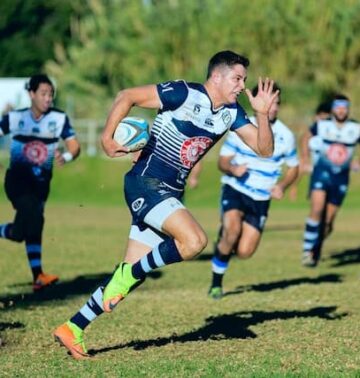
Sometimes you will receive the ball with plenty of room to move. This is when you can take advantage of your superior speed.

Photo of a rugby winger with room to move Rugby wing with room to move

With the scrum near the centre of the field the team may choose to have one centre either side of the scrum, with a wing outside each one.

The side putting the ball into the scrum (or the lineout) tends to determine the way the backs line up.

It is usually the side "putting in" the ball which will get it back, so the other side prepares to defend by matching the opposing line-up.

As you can see, plenty has to go well before you get your hands on the ball if you are a winger. That`s why many wingers go looking for the ball.

Some make the mistake of doing it too much or at the wrong time and are caught out of position when it really matters.

Size of a wing in rugby

Winger...physique... anything!

Thank you to Wikipedia (the links below) where I confirmed the vital statistics... and the award to Shane Williams.

Examples:

Shane Williams Jonah Lomu
1.7m (5' 7") 1.96m (6' 5")
80kg (12st 8lb) 120kg (18st 13lb)
.

Shane - relatively small, fast, nimble, elusive. Shane was named IRB International Player in 2008 and is famous of course, especially for sidestepping.

Jonah - large, heavy, strong, fast - all used to advantage. Jonah is famous too, of course, especially for not sidestepping!

Left wing or right wing

The two wings in a team tend to specialise

  • one as the left wing...closer to the left touch-line
  • one as the right wing...closer to the right touch-line

Which wing you choose is mostly about feeling comfortable and where you function best.

If you feel best

  • receiving a pass when the ball is coming from your right
  • prefer to carry the ball in your left arm
  • like running round someone going left

  • doing a hand-off (also called a palm or a fend) with your right hand
  • prefer kicking left-footed

then you may be best on the left wing

If you feel best

  • receiving a pass when the ball is coming from your left
  • prefer to carry the ball in your right arm
  • like running round someone going right

  • doing a hand-off (also called a palm or a fend) with your left hand
  • prefer kicking right-footed

then you may be best on the right wing

Of course if you are good with both sides of your body you will be good on either wing.

Good to have are...

  • Speed to burn - essential
  • Acceleration is useful
  • Good hands for taking the ball while running at speed

also

  • Agility, the ability to swerve and/or sidestep
  • Or the bulk to make being elusive unnecessary

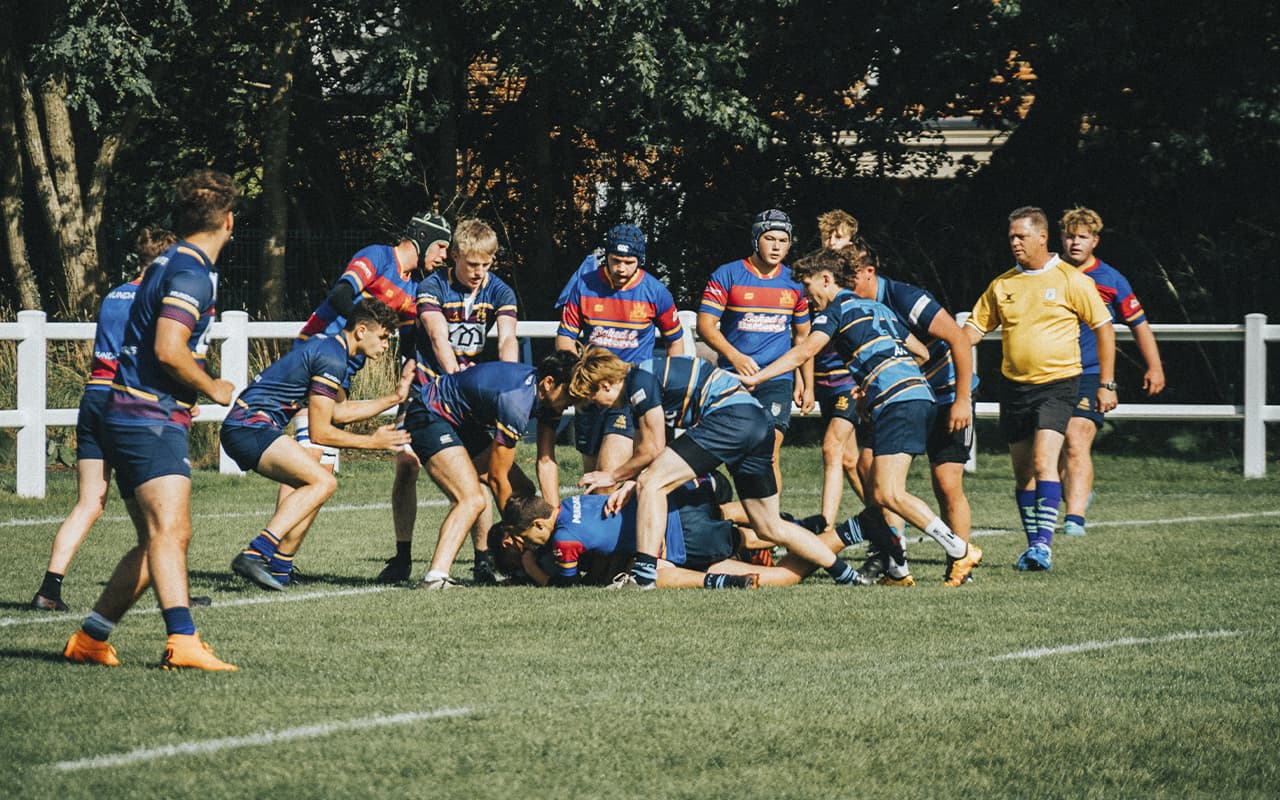
Rugby wing - at scrum time

Scrums restart play after a minor breach of the rules.

Scrums are a contest for possession of the ball with a small advantage given to the non-offending team.

If your forwards win the ball it goes to the half-backs who make decisions about where the ball goes next.

The decisions they make greatly affect how each rugby wing is involved in the game.

Sometimes half-backs will kick for field position or into space.

As a winger you chase after the ball if it`s on your wing

  • try and regain possession
  • or charge down any attempted clearing kick
  • or contain the opposition player who gathers the ball

Remember, you must be behind your kicker when the ball is kicked ahead or you are "offside" and must stay out of play.

Sometimes the half-backs attack by moving the ball to faster outside backs.

This is where you really shine as a rugby winger.

  • Either you catch and run past your opposition using speed and elusive running and go in for a try!
  • or you may take the ball into contact with the opposition.

Or you may continue play with a clever kick

  • a chip and chase or maybe a crossfield kick to the forwards
  • or maybe pop pass the ball back inside to players rampaging through to support.

The half-backs may run, to get across the advantage line and/or move it to the centres.

You, as wing, position yourself in support of the centres with excellent rugby timing so you give them options in continuing the play.

If you are a rugby wing and defending you must tackle your opposite number.

You may find yourself in tricky situations. The opposition may be coming at you with the ball in hand and more players avilable than you have defenders to tackle them.

Believe in the abilty of the players inside you and stay in position to tackle your own player.

If possible, hold up and delay opposition play as much as possible. Cover more than one player by giving ground, staying between them, delaying committing to a tackle, always making certain you can take yours.

Fake a move to make a tackle but keep your distance. Aim to cover your player, slowing other players enough for them to be picked up by other players coming across to help.

Only when absolutely necessary tackle someone other than your opposite number.

It is sometimes necessary to drop back and position yourself to reduce open spaces which are tempting targets for long kicks by the opposition to improve field position.

You may also find you are needed to catch "up and unders", designed to to make ground and unnerve players trying to catch them.

Rugby wing - at line-out time

The line-out restarts play after the ball has "gone into touch".

The duties of the rugby wing at line-out time are similar to scrum time.

You communicate with the centres so you know when the ball will be kicked ahead or whipped out to you when you have plenty of room to move especially if you sidestep!!

Always be aware that plans do sometimes go wrong and you must be prepared so that you can do anything required to rescue the situation.

Rugby wing - in general play

Wings tend to be elusive, skillful, speedy, tactically aware players.

When you are on the wing, the play of the half-backs and centres has a great bearing on what you do.

Depending on circumstances you must be ready for any of the following

  • for carrying the ball past the opposition using raw speed
  • for carrying the ball elusively, skills in side stepping, swerving and changing pace are useful
  • for chasing long kicks to gain ground, work on your speed

  • for diving on a rolling grubber kick in the in-goal area to score
  • to catch cut out passes which create uncertainty for opponents
  • for moves called to confuse the opposition

  • for a dummy pass from the ball carrier
  • for opportunities to get the ball to supporting players

As you can see your role involves a lot of waiting around!

Use waiting time well

Rugby wingers have to

  • study what is going on
  • try and predict what will happen next
  • learn to read the game

Then, when suddenly involved and there is little time for you to think or get your bearings, you know all about what`s happening.

You know as much as possible about the game so you don`t need to think, you act swiftly and decisively.

Put another way, thinking about other things when you are playing rugby is not a great idea so do it now!

Imagine for a moment

  • your sidesteps puzzle loads of players
  • create space for yourself and others
  • your team scores loads of tries and wins

Lots of players imagine it`s a wonderful feeling for those who do it.

It`s not hard, you know, to believe.

Here`s a good example. Rugby wing Jason Robinson (British and Irish Lions) beats Chris Latham (Australia) with a great but subtle sidestep.

The commentator says "in and out". Carefully watch Robinson`s leg action from the side at around 18 seconds (and again at around 46 seconds).

Robinson makes it look so easy but I believe Latham would have picked off most other wingers given the same situation because they just don`t have the sidestepping skill demonstrated here.

Get your own sidestep - go to our EvtecHs page

Good rugby wingers practice

When you are a good winger..
...you are a good winger because you practice.

You know when you learn you still have to practice enough but you enjoy it so much because you know you will be good.

Players like Gerald Davies and Jason Robinson were not born in their rugby positions, be like them...

  • find out what you do
  • enjoy what you`re doing
  • practice enough over time so you are superb

To get more idea of the size and build of wings in relation to other positions look at details of elite players on our page player sizes.

Some famous players, good wingers...no special order!

Gerald Davies
David Duckham ( also centre)
David Campese
Jonah Lomu
John Kirwan
Shane Williams
Bryan Habana
Bryan Williams
Ron Jarden
Jason Robinson
Rory Underwood

One skill common to many famous wingers is the the most elusive skill of all. Want to be one - make rugby sidesteps part of your game.

New! Comments

Like it? Questions? We`d love to know! Share it, comment below!!